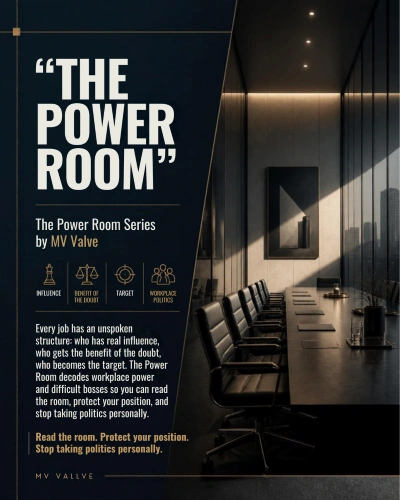
The Power Room Collection
Every workplace runs on an architecture nobody draws out loud. There's a room built from hierarchy, favour, and unspoken rules, and the moment you walk into a job, you're standing inside it whether you've named it or not. That room decides who gets heard in meetings, who gets the benefit of the doubt, who gets quietly side lined, and who becomes the target when a boss needs someone to blame.
Most people spend years inside that room reacting to it instead of reading it. They take a difficult boss personally instead of recognizing a pattern. They absorb blame that was never theirs to carry. They mistake someone else's insecurity for their own failure. Without understanding the structure underneath workplace behaviour, every difficult moment feels like a referendum on their own worth, when in reality it's often a symptom of the room itself.
The Power Room exists to change that. This series decodes the psychology of workplace power: why certain bosses behave the way they do, how office politics actually operate beneath the surface, what silence and favouritism are really communicating, and how authority gets built, protected, and sometimes abused. It gives language to dynamics people have felt for years without ever having the words for them.
This isn't generic career advice. It's a way of seeing the room clearly enough to stop absorbing what isn't yours, hold your ground without losing your position, and make decisions about your work life from clarity instead of confusion. Whether you're dealing with a boss who targets you, a workplace where politics override merit, or the quiet erosion of confidence that comes from being in the wrong room too long, this series is built to help you recognize the structure, protect your identity inside it, and decide what you're willing to keep standing in.
Power Has Rules
Get the Playbook→
https://www.paypal.com/ncp/payment/XTZ8J7JNN5H7G
Why Does Everyone Seem to Know the Rules Except Me?
The written rulebook covers dress code and reimbursements. The real rulebook decides who gets promoted, who gets forgiven for a mistake, and whose ideas are allowed to sound confident. It is never written down, because writing it down would expose it.
Here is the part that surprises people. It is often not the low performers who get blindsided by this. It is the highest performers, because they were so confident in their work, they assumed the unwritten rules simply did not apply to them.
So next time you ask why everyone seems to know something you do not, ask a better question instead. What are the people moving easily through this room actually doing, that nobody officially taught them either.
Power Has Rules
Is My Boss a Bully or Am I Too Sensitive
Get the Playbook→
https://www.paypal.com/ncp/payment/D2CDGYTSUMN3Q
You have asked yourself this question more than once. Probably after a specific meeting. Probably late at night, replaying a message or a tone of voice, trying to work out if you are dealing with a difficult person or if you are the difficult one.
Here is what nobody tells you about that question. It is not actually a question. It is two accusations, and both of them end with you finding someone to blame before you have looked at the actual evidence. if you have already worked out that something real is happening, a second question usually follows right behind it.
Why me. Why does this seem to happen to you specifically, when your co-workers walk through the same room untouched.
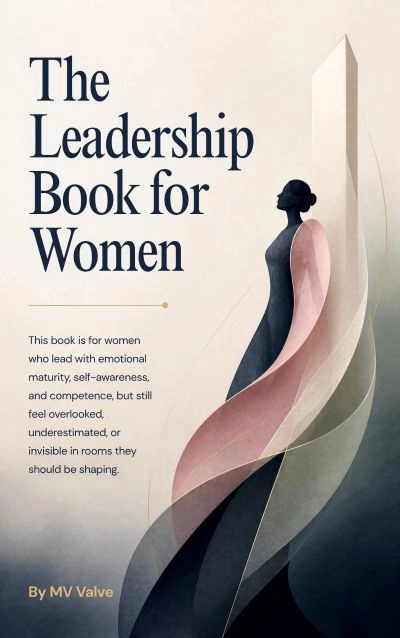
The Leadership Book for Women
Get the book→
https://www.paypal.com/ncp/payment/QJ9EYRA5TD8BG
This book is for women who lead with emotional maturity, self-awareness, and competence, but still feel overlooked, underestimated, or invisible in rooms they should be shaping.
f you've ever felt relied on but not recognised, calm but misread, or capable but undervalued, this guide will give you the clarity you've been missing.
This is not about becoming louder. It's not about performing confidence. It's not about changing who you are.
It's about understanding the patterns that keep emotionally intelligent women unseen and learning how to shift them in a way that feels grounded, authentic, and aligned with who you already are.
Leading Through Crisis.
Get the book→
https://www.paypal.com/ncp/payment/S5SHCSKX227LU
The Moment Leadership Breaks Quietly.
This book explores the four crisis patterns that push leaders toward their breaking point
Leadership rarely breaks in public. It breaks in the quiet moments no one sees. It breaks in the space between responsibility and uncertainty, between expectation and reality, between the leader you want to be and the leader the moment requires.
Crisis does not announce itself. It arrives through pressure, complexity, and decisions that carry emotional weight far beyond their operational impact. It arrives through moments where clarity dissolves, values collide, and the cost of choosing becomes heavier than the choice itself.
Leaders are often praised for their resilience, their composure, their ability to stay steady while everything around them shifts.
Very few people speak about the internal world that makes this steadiness possible. Even fewer speak about the emotional cost leaders absorb in silence.
When Being Liked Costs You Leadership.
Get the book→
https://www.paypal.com/ncp/payment/PRMJZWDM2TXJC
No one admits it, but likability is a form of social currency. It buys access. It buys safety. It buys tolerance for your mistakes. It buys patience for your learning curve. It buys forgiveness for your ambition. People don't just respond to what you do they respond to how you make them feel about themselves.
If you make them feel comfortable, they reward you. If you make them feel confronted, they correct you.
This is why so many leaders especially women learn to treat likability as a survival strategy. Not because they're insecure, is due to how they've learned that being liked protects them from consequences that others never face.
Leadership is not a destination you reach through effort. Leadership is a homecoming. It is the moment you return to the version of yourself you abandoned to be liked, approved of, or understood.
